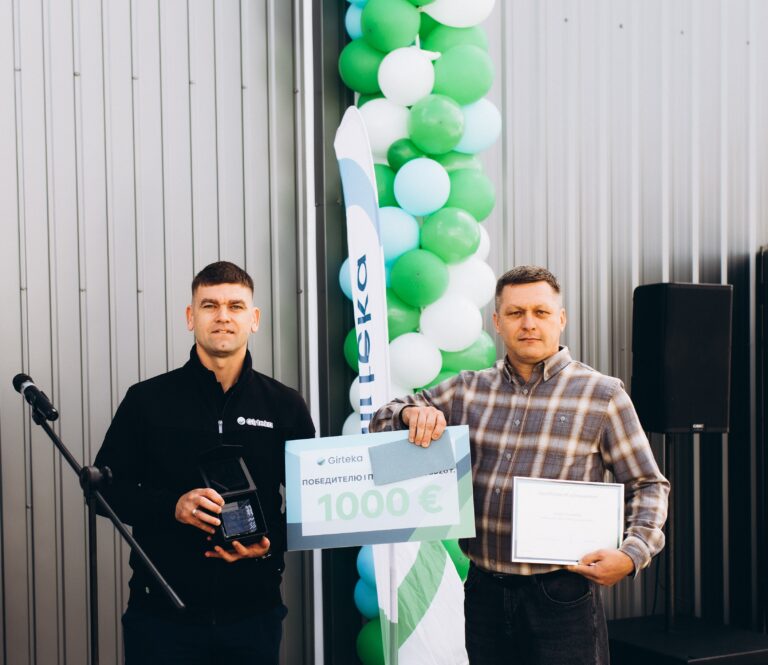
“Don't be ashamed to ask. A good driver never stops learning.”
– Darius, instructor at Girteka “Driver Academy”
Many of our drivers who go through training at the Girteka “Driver Academy” in Šiauliai know Darius personally. He’s been working as an instructor in our company for almost four years. He works with both new employees and experienced drivers who want to refresh their knowledge, analyze challenging situations that might happen on the road, or get hands-on support.
He didn’t end up in this career by chance. Darius worked as a driver at Girteka himself and knows the job inside out. Even back then, he was already thinking about how he’d train others one day.
To become an instructor, he earned a degree in Transport Engineering, completed the required training, and passed his exams at Regitra. And he’s still building on those skills today.
Languages are a real asset in his work. Darius is fluent in Lithuanian, Russian, and Spanish, and also speaks English. That matters, because Girteka’s drivers come from many different countries – and each one needs things explained clearly and in a way that makes sense to them.
Training is not a formality
According to Darius, no two days are the same in an instructor’s job. He runs both theoretical and practical sessions as well as works with drivers who’ve been involved in accidents. Together, they go through what happened, discuss how it could have been prevented, and work through it in practice.
Darius often comes across drivers who show up to training already confident in what they know. That’s especially common among the experienced ones – they’ve been on the road for years and are sure they’ve seen it all. But that kind of confidence sometimes can get in the way of hearing what really matters
“If training were just a formality, it would be easier for the company to put a driver straight on the road. But Girteka invests time and resources in training, because safety and quality start with a strong, shared foundation from day one,” says Darius.
A driver’s job in international transport involves much more than getting from point A to point B. Drivers need to know the regulations on driving and rest times, how to secure cargo properly, how to handle paperwork, operate the technology, monitor the vehicle’s indicators, and respond to all kinds of situations on the road.
At Girteka’s training centre, drivers don’t just gain theoretical knowledge – they build the practical skills they’ll need on the job. In hands-on sessions, they learn how to fit snow chains, safely couple a semi-trailer, install load bars, secure cargo with straps, operate refrigeration units, and handle the other tasks they’ll face out on the road.
Importantly, learning doesn’t stop once the exam is over. Drivers can reach out to instructors for advice later on, even outside of scheduled training. All the key information is also available digitally.
The most common mistakes
Among the most common mistakes, Darius points to drivers not checking their mirrors often enough, not keeping a safe following distance, exceeding speed limits, and getting distracted by their phones while driving.
He especially highlights speed limitations. Drivers sometimes forget that strict speed limits apply to trucks in most European countries.
“From what I’ve seen, and from the statistics, drivers who speed are also involved into accidents more often,” he explains.
There’s another side to it: the faster you drive, the more fuel you burn. That affects the efficiency of the haul and the bottom line. That’s why eco-driving at Girteka isn’t treated as separate from safety – the two go hand in hand.
“If a driver stays calm, pays attention, and doesn’t rush unnecessarily, they’re driving not just economically, but safely too,” Darius notes.
What sets a strong driver apart
Over the years, Darius has learned to quickly read how someone approaches learning. In his experience, a skilled driver isn’t defined by age or years on the road. Sometimes very young drivers turn into real professionals fast – because they ask lots of questions, listen carefully, and want to understand the details. And sometimes an experienced driver shuts down to advice, convinced there’s nothing left for him to learn.
Darius says what matters most is curiosity and a willingness to take in new information. Sometimes, there are cases when a driver with many years behind the wheel has never had proper training before, and that’s why they make mistakes. But if they’re willing to listen and try, the results come quickly.
“The greatest reward for an instructor is seeing the interest in a driver’s eyes and knowing that the person has genuinely learned something,” he says.
The main advice for drivers
Darius remembers his own early years as a driver. So, his main piece of advice is simple: don’t be ashamed to ask.
“Nobody is born knowing everything. Ask your instructor, ask your colleagues, and ask other drivers – especially during training. Every instructor at the training centre is there to help. Asking questions only makes people respect you more,” he says.
That advice isn’t just for newcomers. Experienced drivers also need to keep their knowledge up to date. Rules, technology, processes, and requirements all change. Sometimes a person missed something, forgot it, or never quite took it in the first place. That’s why refresher training matters.
That kind of approach to work and to learning – is what makes a real professional. Because a good driver isn’t just someone behind the wheel. It’s someone who thinks ahead, asks questions, makes decisions, and never stops learning.